
The Blue Eye
Of all the floral species found on the continent of Europe, nearly one third of them can be found in the small country of Albania. Even though it is rather obvious that Albania is an ecologically diverse country for its size, one third of Europe’s plant species was a surprise to me. A great deal of the countryside I had witnessed driving in the area south of Tiranë to the Greek border was shrubs, rolling grasses, and some typical looking mixed forests. Green and beautiful goes without saying, but when I think of ecological diversity I think of a dense impassible jungle on the side of a volcano in Africa. Not shrubs and trees similar to the Eastern United States. That was, until we came to the Albanian rainforest.
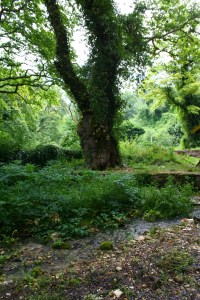
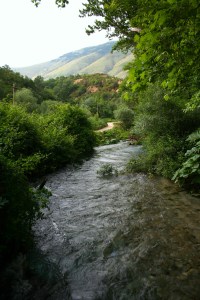
The area around the Blue Eye, or Syri i kaltër, outside of Sarandë is not really a tropical rainforest of the Brazilian or Congolese type. However, that does not dampen the tropical feeling elicited by Syri i kaltër. From the area outside the forest to the path that leads to the Blue Eye, the temperature dropped from midsummer to late fall. The shrubs and somewhat typical trees gave way to vines, plants with giant leafs, and trees packed so closely together that a blanket of foliage formed around them. The air became clearer, and the dampness of everything brought out the scent of the plants. We met up with a stream of water that obscured the riverbed on which it flowed only because of the speed at which the water rushed past us. At the end of the relatively short path, the trail opened up slightly onto a small pebble beach that frames one side of a spring.
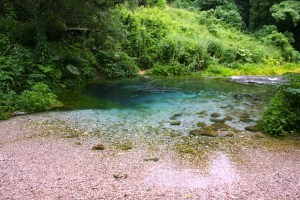
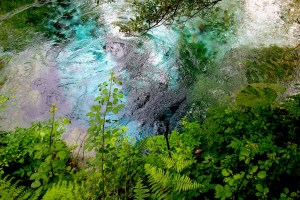
The pool is literally hypnotic. On multiple occasions, I found myself staring into the gradient of cool blues and greens in a near mental silence. Damp forests with quiet ponds and babbling brooks have a calming touch, but something made time slow down here. Perhaps it was the clarity of it all. The shades of blue that emanates from the vertical cavern from which the water rises probably do not exist anywhere else on earth. I imagine the Blue Eye got its name from some sorrowful soul who was reminded of a lost love’s eyes by the colour of the pool. This might not be too far from the truth, sappy as it may be. In fact though, the spring does resemble an eye. The deep pit in the centre from which the water flows is at least one hundred fifty feet deep; beyond that depth it is unexplored. This makes up the black pupil of the eye. Around the pupil, where the spring has eroded, but to a far less extent, is a deep and vibrant blue iris. Outside that, the gradient turns lighter to the sclera, which is only shallowly sunk light coloured pebbles. From the eye, the water flows to the sea along with a dozen other springs in the area.
As is the case with most beautiful places, in communist times the Blue Eye was kept from the general public. There is next to nothing written about physical history of the spring beyond that sentence. I find it an interesting natural monument to the way in which much of history can be lost. Just as the water flows away from it, and many things thrown into it soon bubble back up and wash away, the story of a place can easily get lost. It is a very powerful foil to the bunkers that are a constant reminder of the past in Albania. The Blue Eye clearly has meaning for people. It is shrouded in legends that may themselves be ancient and it was important enough that people felt restricted access was needed. Yet there is no nod to the history Syri i kaltër may have helped to create, or to which it was direct witness. It is easy to forget what transpired around a place when it can only be seen in light of its modern circumstance. Communist elite in cocktail dresses smoking cigarettes once stood on the shores where people now dare each other to jump into the slightly above freezing water. Maybe not, but you get the point. There is a clear human element to the obviously natural phenomenon that is the Blue Eye, but most of that human element is invisible.
4 June 2012
Links:
 Steerage Yearns
This brings so much more appreciation to my sample of the Blue Eye! Thank you for sharing, it makes living vicariously through you better than ever!