
Uplistsikhe
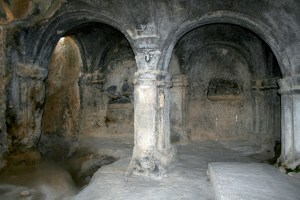
I have mentioned the town of Gori in Georgia before in “The Stalin Museum” as it relates to the 2008 war and the home of Joseph Stalin. The history of human settlement in the Gori region however, reaches much further into the past than that. Uplistsikhe is a four thousand year old cave settlement of sorts with dozens of enclaves carved from a sandstone hill just outside of town. I use the term “cave settlement” loosely, hoping not to elicit images of brutish, hunchbacked, and hairy cave men knocking each other on the head with clubs. Rather, these caves are decorated with hand carved arches, geometric ceilings, and intricately laid stonewalls.
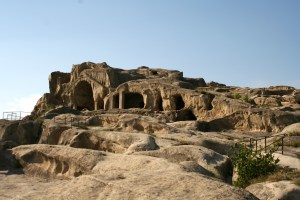
From the small parking lot at the hills base, we paid the entrance fee of 3GEL (~2USD); a small amount for the size and amount of upkeep necessary at the site. We took a fork to the right from the relatively well-maintained path, which climbs from the riverbank up toward what we believed to be the direction of the settlement. The climb took us up over boulders and up flights of wooden stairs before dropping us off at the edge of an expanse of grey Swiss cheese. My immediate reaction was to find something to brace myself on from the roaring wind that came flying up from the Mtkvari River at the bottom of the hill. The wind carried lose sediment with it and sand blasted everything in its way. As a result, most of the features on the mountain had been eroded into rounded flowing corners that smoothly carried the air. Through the gale force winds, the true expansiveness and beauty of the place was apparent.
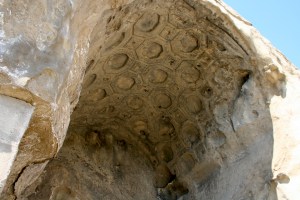
The first structure that was readily visible was a group of rounded entrances to rooms carved from a projection above the general plain of the rock. The largest of these entrances gives off a strange gothic feeling. Its original shape of an arch under a triangular frame has been eroded enough that the rock appears to be melting down its front face much like a decorative candle. Inside the recesses, intricate designs that have not felt the sand filled wind are carved onto the ceilings. When considering the natural forces the settlement has endured for more than a hundred generations, I found it difficult to comprehend how anything remained. An earthquake in 1920 and years of vandalism have caused damage to the area. Uplistsikhe has been on the tentative UNESCO World Heritage Site list since 2007 in hopes of bettering its preservation.
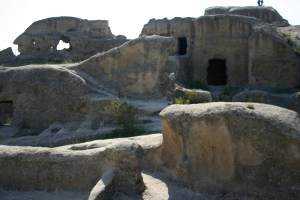
To one side and beyond the main entrance, the ground gives way and falls deep into an amphitheatre ended by a covered multi room stage. The walls and ceilings are stained black with soot from fires that burned as part of alters in the distant past. In all there are areas on the site that harken back to a Hellenistic theatre, a system of sewer drains, pharmacies, churches, and merchant areas from when it was associated with the Silk Road. Up above the stage looking area, near the apex of the local hill that encompasses most of the structures is a modern Christian Basilica, Uplistsulis Eklesia, from the 9th and 10th Centuries CE. It is still used today.
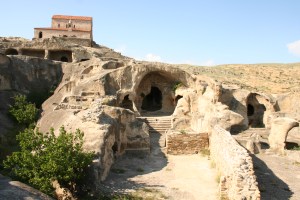
I have mixed feelings about the churches presence at the settlement at all. For one, it sits on top of an older temple to the sun. Personally, I disagree with their choice in placement. The Salt Cathedral in Colombia is one of my favourite places and I would hate if one day if it were covered up because a more powerful religion decided it would be a good tool for converting the local unenlightened Catholic population. I hope if that ever happens, someone will be equally disappointed that the architectural and emotional appeal of that cavern was lost for the sake of what is en vogue. In addition to the issue I take with it historically, aesthetically it looks a little stupid. All the other preserved structures are very natural and come together well, even though they were not all constructed at the same time or by the same culture. Each of the other enclaves or areas make sense together and show nice gradual change over time that took place at Uplistsikhe. Then there is the basilica. It is a harsh rectangle, and doesn’t even fit in with typical churches from the rest of the country. Without any historical knowledge of the site it should be obvious to anyone that the basilica does not belong there. To that argument however it may be said the age of the thing in itself makes it an important part of the site. After all, how many people know the history of the horses at St. Mark’s Basilica in Venice, Italy? They may not belong there depending on your point of view, but their movements through history are unarguably a huge part of their interest.
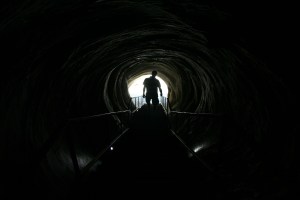
The final stop we made while perusing the hilltop of Uplistsikhe was a rather unexpected find. Around and behind a group of boulders relatively near the entrance, a makeshift path wound down and under a rock overhang to a dark tunnel. The stairs ran down into the hill before turning lightly to reveal an exit at the bottom. The tunnel lands right at the edge of the Mtkvari River, and was probably used for that reason historically. Uplistsikhe, while impossible to pronounce, is a beautiful monument to a more elegant and beautiful history in a town that in recent memory is only remembered by many for less than glorious events.
17 July 2012
 Steerage Yearns