
Muthi Market
On my last day in Africa, some of my traveling associates and I picked up a guide to take us around the city of Durban, KwaZulu-Natal. It is easy to get caught up in all of the breath taking nature and easily accessible tourist friendly activities around Durban, and miss out on the thriving heart of the city that for years was pushed to the periphery.
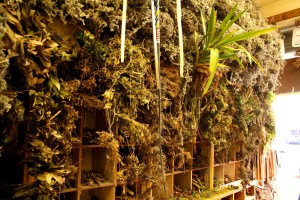
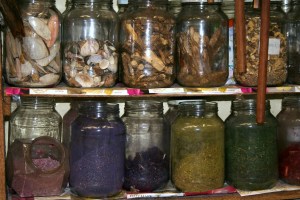
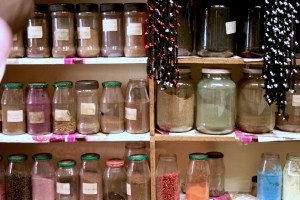
We started off at a Zulu herbalist’s store in the area by Victoria Street Market. As an eighteen year old just out of a rather poor high school education two months earlier, the only way I knew to describe such a place was a Witch Doctor’s Office. It was a long narrow store divided long ways by a counter, not unlike a small pastry shop or bakery. The options were however slightly different from an everything bagel with cinnamon sugar cream cheese. On one wall, wooden cubbies were stacked with branches and roots; others were packed with more species of vines, leaves, and mosses than I could name at a well-stocked grocery store. The other wall was lined by shelves stacked with jars of powders, soils, beads, shells, and bones. The counter itself was cluttered with boxes and newspapers that contained ground up mixtures of the various products; orders in the process of being filled. People came and went every few moments picking up their necessities from the doctor.
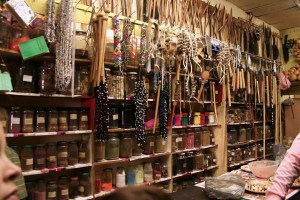
While my younger self was not too far off, there are obviously more accurate names than Witch Doctoring for what was going on inside the shop. Muthi, traditional Zulu medicine, is sold all around the Grey Street area in Durban. Most of the plants used in muthi are dried and then ground into powders ranging in consistency from dust to coarse wood chips. Each one imparts some sort of physical, mental, or spiritual treatment on the patient. They can be taken in a variety of ways, which usual involve steeping into a tea to drink or to sit in as a bath. One muthi clears the digestive system, and another brings luck. They are innumerable in their uses and combinations. The inyanga or an herbalist mixes various ingredients to suit the requests of their clients.
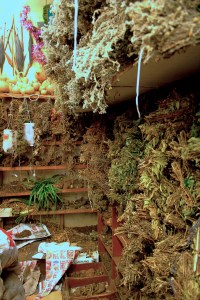
A man behind the counter handed me a small piece of bark from one of the mixtures he was working on, and motioned for me to eat it. With only moderate trepidation, I took it and chewed away. I finished my treat and considered what to expect, praying that it was not one of the treatments meant to be thrown back up after consumption. Luck or intelligence might be about to wash over me, and I didn’t want to miss it so I did my best to ignore the negative possibilities. As some the repercussions of mindlessly eating things from an herbalists shop began to form in the back of my mind, my mouth began to burn. My tongue felt like it was slowly cremating itself while the man laughed a little bit and smiled at his handy work. He took another piece of material from a jar and pushed it toward me. I gave him my best “Are you insane!?” look. He laughed a little bit more and insisted, shaking the small brown chip at me. I again conceded, knowing it was my last full day in Africa and well, why not. The second piece was a softer than the first, and fell apart into a gritty powder rather easily. The instant I bit into it, the burning sensation left my mouth and was replaced by a gentle sweet flavour. It was obvious my facial expression confirmed what he thought would happen. He laughed some more and nodded before returning to his concoctions. I am still looking forward to the results, which I am sure, will be beneficial to my physical and spiritual well being.
Outside and in the depths of Grey Street, the array of muthi ingredients became even more apparent. Stalls with varying degrees of structural boundaries ran all along Grey Street from the Victoria Street Market towards the Warwick Triangle. Many were simple open-air plots with a woman sitting behind a blanket, but others were more permanent buildings like the storefront I mentioned earlier.
The piles of leaves were now in the company of a vast array of the macabre and bizarre. Most of which were shades of black, brown, grey, and tan. Whole dried baboons were hanging from tables and roofs. Dried fish stacked into neat rows on the sidewalk. Skulls from innumerable species of bird, mammal, fish, and reptile; fleshed birds’ legs; and crocodile teeth were all hanging from ropes, laying out on cloths, or overflowing from bags. Almost any of it could be ground up and used in a muthi. I was thankful that there would probably not be any more free samples. Mixed in with the monochromatic and at first terrifying selection were splashes of colour. Spices with oranges and yellows filled burlap sacks, and powders so pink they could not exist in nature were being thrown into various prescriptions. The range of smells was equally great. Smells of rotting flesh were mixed in with those of Indian spices and scents that are unique to a given stand at the market.
The Zulu Muthi Market in Durban is an absolutely beautiful example of cultural persistence and presence. Somewhere that just plain does not exist in the same form in Western Europe or North America. The opportunity for homogenization of culture in South Africa is ever present. There are Zulu, Afrikaners, Europeans, and Xhosa all packed into the area of KwaZulu-Natal. A minibus driver put it this way, and I think it rings rather true: “The United States is a lot like a soup, different ingredients all put together and end up tasting the same, but South Africa is more like a salad, everything is together, but very much distinct in its own right.”
25 July 2008
 Steerage Yearns
I love your blogs, your descriptions let me go to the places I didn’t travel to with you and your sense of humor makes reading them delightful!