
Arizona Archaeology
For this entry, I am going to take a break from the far away (at least relative to my home in Minnesota) and make a quick tour of my old back yard. As a relatively young country, most people rightly assume that there is not a great deal of history older than the colonial era preserved in the United States. It is not a country known for the monumental architecture of the Maya, Aztec, or Inca of Central and South America even though people have been living across both these continents for roughly the same amount of time. As much as I would love to have a stone pyramid just outside my hometown, it just is not the case. However, this is not to say that what can be found here is not riveting.
On one of my last visits to the southwest United States, I had the pleasure of strolling through four sites in Arizona that have been standing for almost two thousand years. Culturally, the sites are attributed to the Sinagua (Spanish for “without water”) and yet each is distinct from the others in striking ways. All abandoned over five hundred years ago, they have literally stood the test of time, and are now under appreciated landmarks.
Driving down from Utah, our first stop was the small valley of Walnut Canyon. The area does not resemble the Arizona most people imagine; it isn’t a dry, dusty and dead wasteland. There are green trees and scrub bushes clinging to the steep walls of a five hundred or so foot deep canyon. Dare I destroy someone’s fantasy of the American Southwest, but it snows here in the winter. At the bottom of the canyon is Walnut Creek, which has carved through three layers of geology that date back to almost 300 Million years ago. That is millions of years before the dinosaurs. The oldest layers of rock resemble a solidified soft serve ice cream cone, wrapping around in a grey fluid pattern. They mark a time when this area was covered in sand dunes. Wind blew the dunes around like slow moving waves before they turned to rock as they are now. Situated on top of these solid dunes is a softer rock that formed in an entirely different environment. This layer formed at the bottom of a shallow sea, from slowly sinking bits of dead sea, like dust on an old dresser. The icing on the cake is a thin layer formed by a volcanic eruption that took place about a thousand years ago.
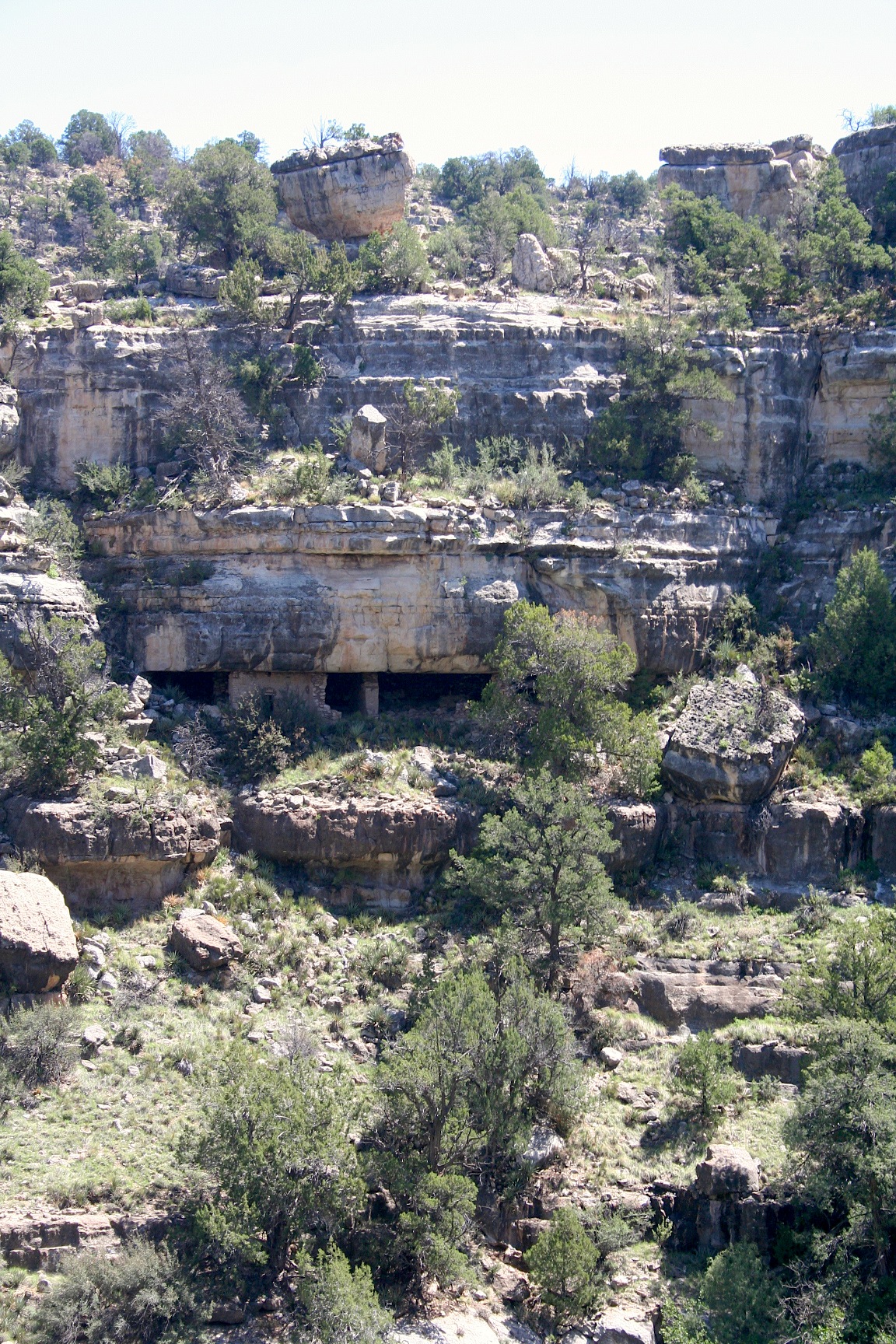
Any time I think of the dramatic changes that take place over geological time I can’t help but imagine that scene in The Time Machine where Alexander is knocked unconscious and goes rocketing through some insane million number of years. Like an elegant time lapse photography sequence, deserts are covered by water which drains away and grows a forest which is burned by a volcano. The sheer amount of time it has taken to build up and carve away at the foundations of Walnut Canyon is simply incomprehensible. Anyhow, I digress. Like usual.
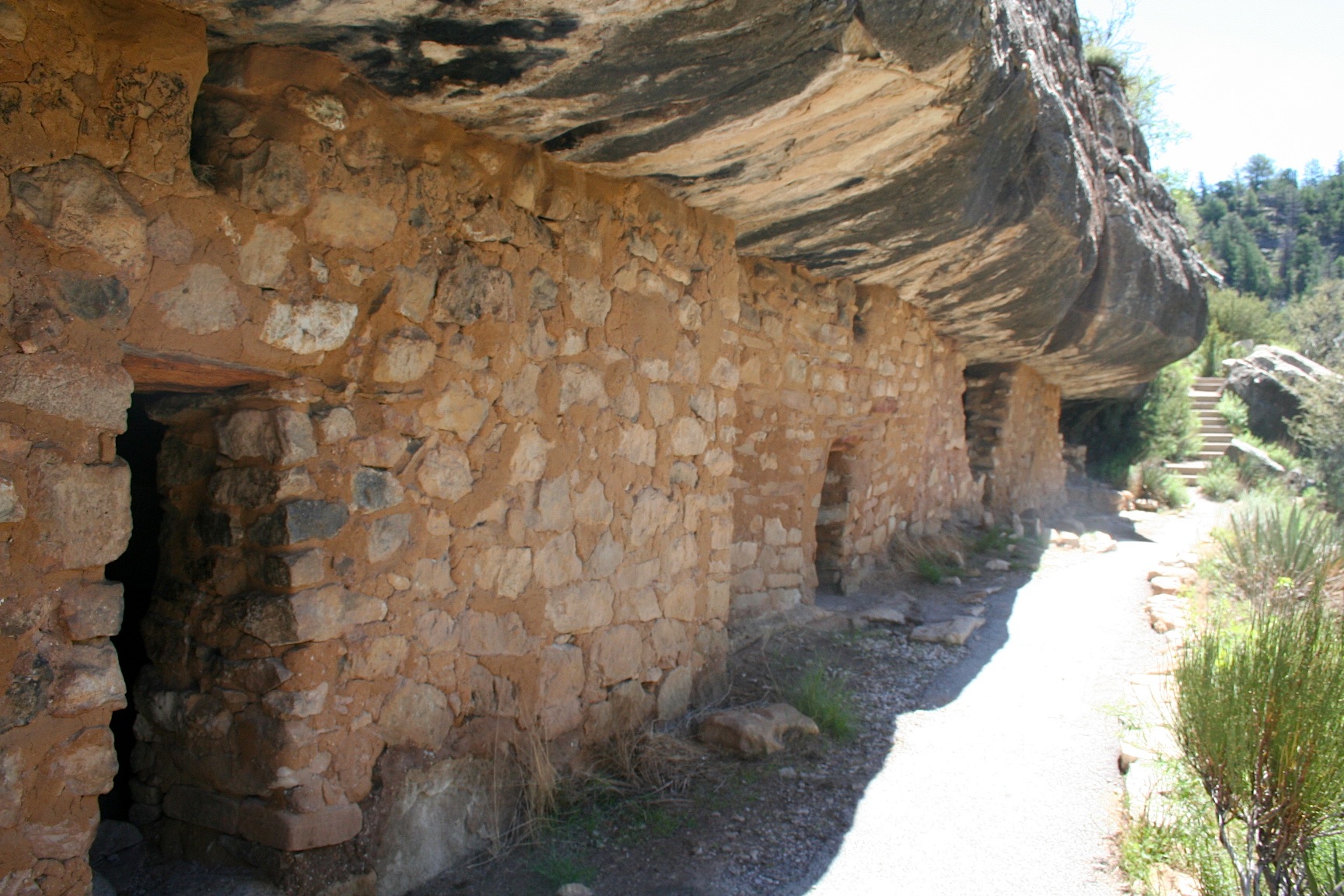
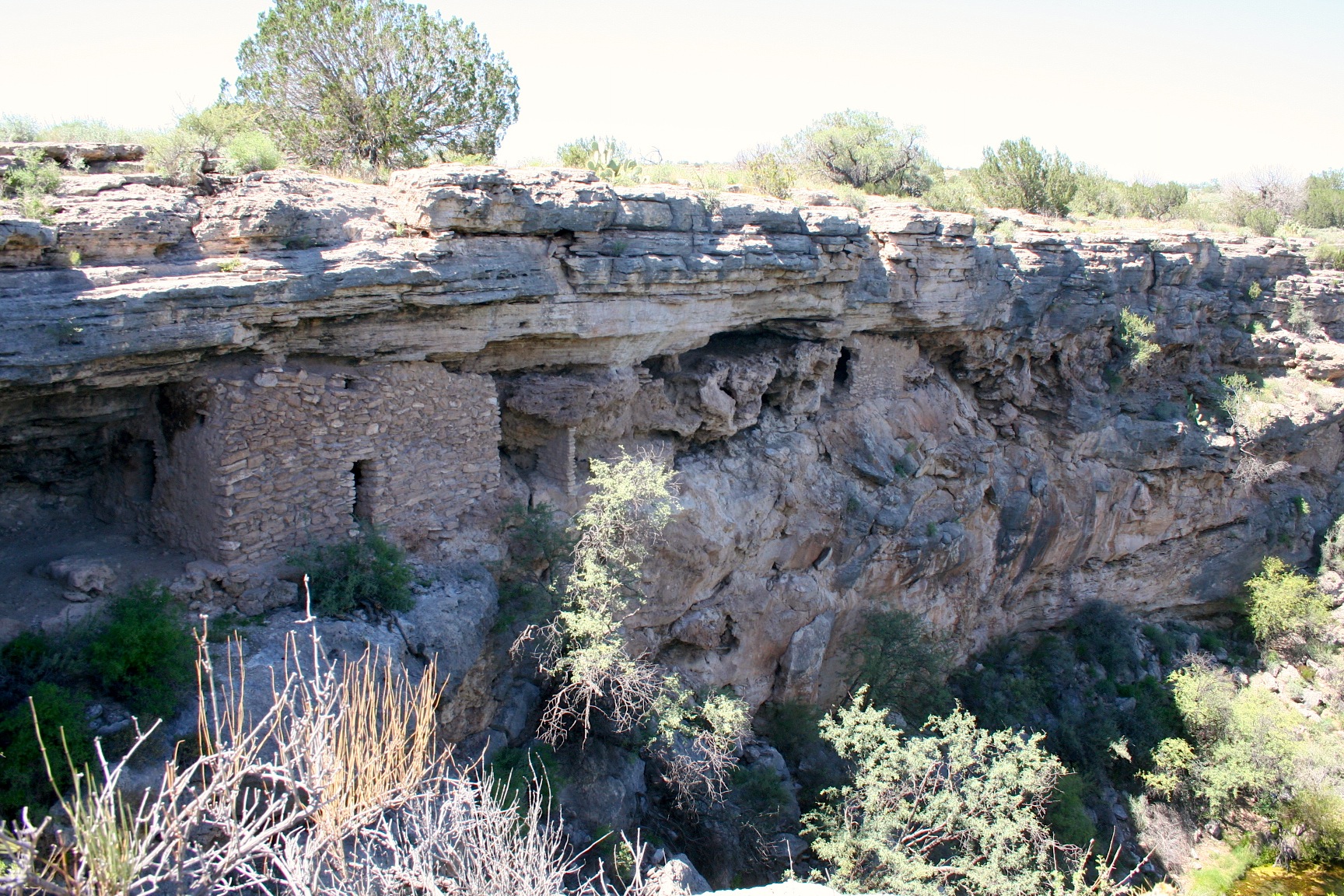
The layers of rock allowed for differential erosion in the canyon to form large rock overhangs that were a natural shelter for the people living in the area. Shallow panoramic caves of a sort. All anyone had to do for further privacy and protection from the elements was build three walls, and this is exactly what they did. Stone and mud were stacked up to create about eighty modest cliff dwelling apartments that look into the canyon. Trails take visitors down into the canyon to about twenty of the small dwellings, which vary in preservation from a few stones at the bottom of a former wall to essentially unchanged and still habitable.
Life in the little spaces would have been an interesting mix of built space and almost subterranean living. With your ceiling, back wall, and floor made out of the rock; the nature you experience is never limited to the views out windows or time spent in a yard, but literally supports your shelter. Not truly cave living, the spaces would have given all the perks of living in the ground, and on the surface simultaneously.
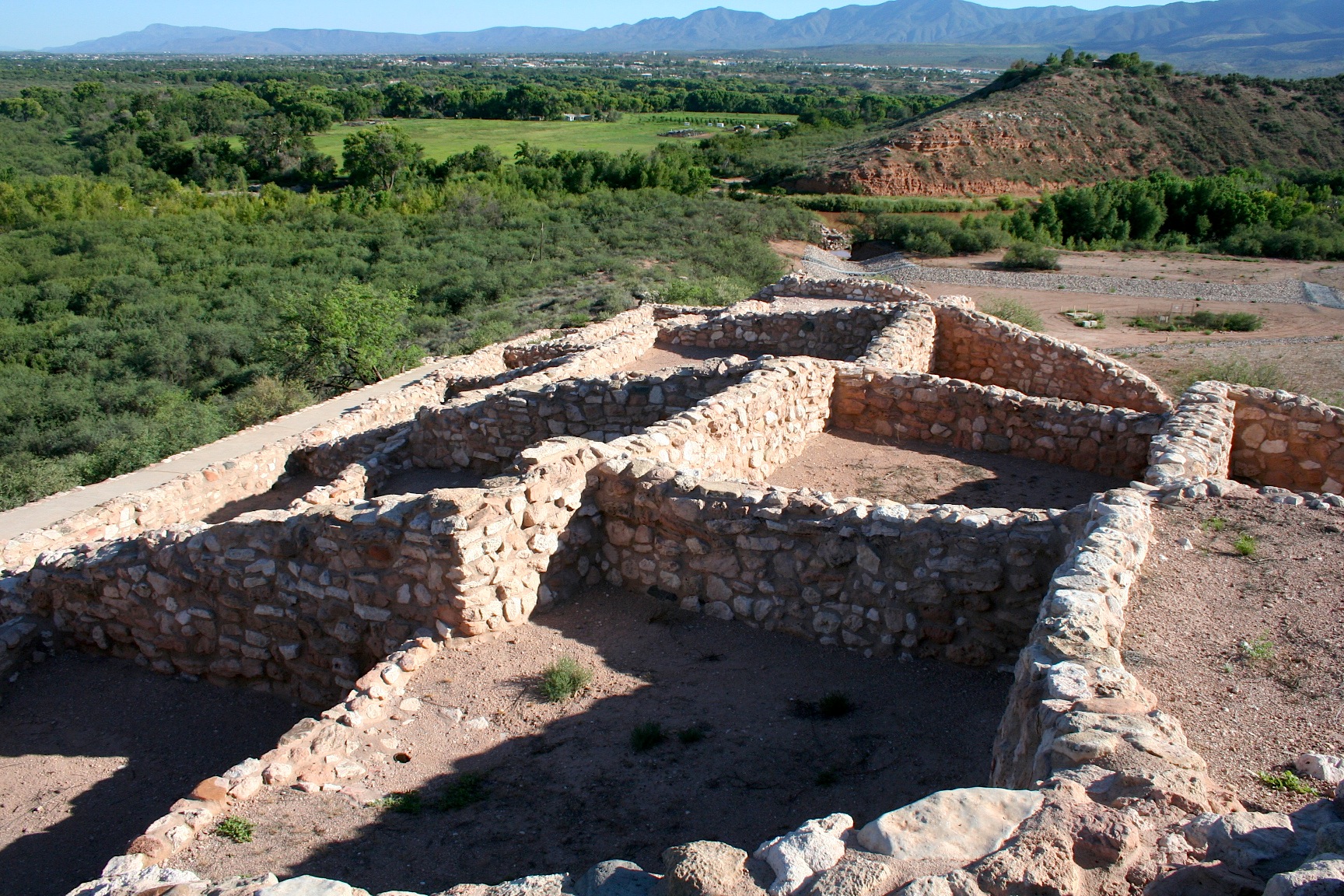
The little apartments are far from an isolated neighborhood. A short drive away is the site of Tuzigoot. Also a former Sinagua quarter, Tuzigoot hardly resembles the small cliff overhangs at Walnut Canyon. The hundred or so rooms, all closely packed together each sharing some or all of their walls, sit atop a small hill. These are the kind of ruins I always imaged when thinking about “Precivilization” ruins in general. Small blocks of square rooms, stone or mud walls, and generally in ruin were the epitome of Archaeology for me at the time.
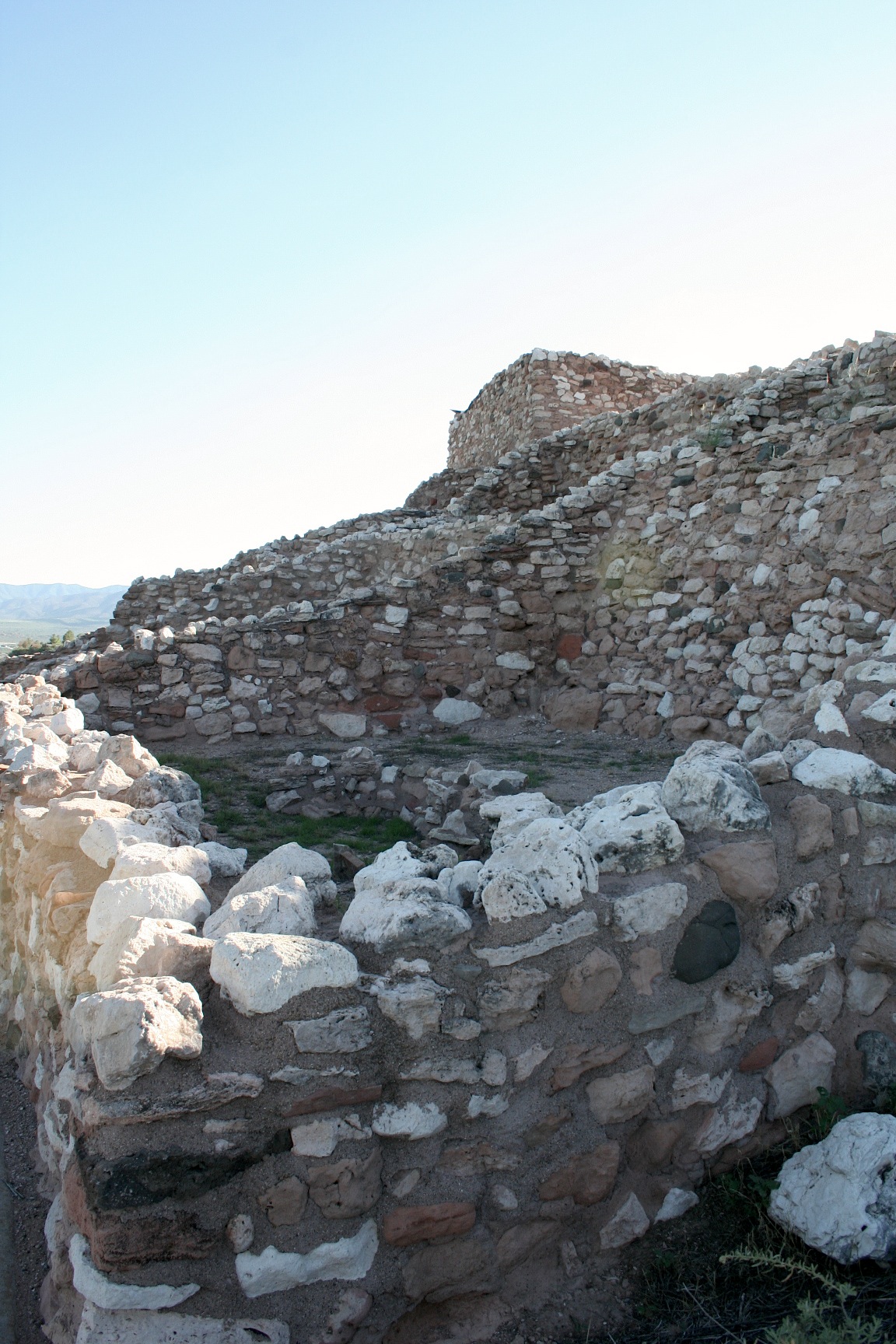
Most importantly however are the empty floors and dust. Lots of dust. By no fault of their own, these sites often lose their personality. Empty floors and dead walls are difficult to personalize when viewed from as an outsider. Here, the walls vary in preservation, but most are a couple of feet tall. For those observant enough, or interested in actually considering some old dry rocks, it should be rather obvious that each of the square enclosures is truly an enclosure. I say this because there are no breaks in the walls for doors.
Packed together like an ancient and smaller version of Kowloon Walled City; the multistory buildings of Tuzigoot had no doors. Where does one keep the front door if not in the front? On the roof of course, covered with trap doors and accessible by ladders. As such, the buildings could act as manmade caves. By doing away with any large outlets like doors, the residents helped minimize the heat allowed into their homes. At face value, there are some small similarities between Tuzigoot and Walnut Canyon. Some of the structures share walls for example. Overall however, to the average tourist, these two sites, while situated relatively close to each other are rather distinct. This kind of distinct architecture is difficult to come by in most places in such small proximity. But the best is yet to come.
For the last portion of our short tour of this area’s pre-colonial archaeology, we made a pass by Montezuma’s Castle and Well. While both sites were actually abandoned a full century before Montezuma was even born, thanks to the good old days of history (not) the name has stuck. The name castle is probably a misnomer. However, that fact should not lead one to believe it is any less of an astounding feat of architecture. With only about twenty rooms, it is the smallest of the housing units I have mentioned so far, but by far the most impressive in my book. The impressiveness is not lost on others however, and it was by far the busiest of the sites we visited that day. Even though, there were hardly crowds of people shoulder to shoulder snapping away with cameras.
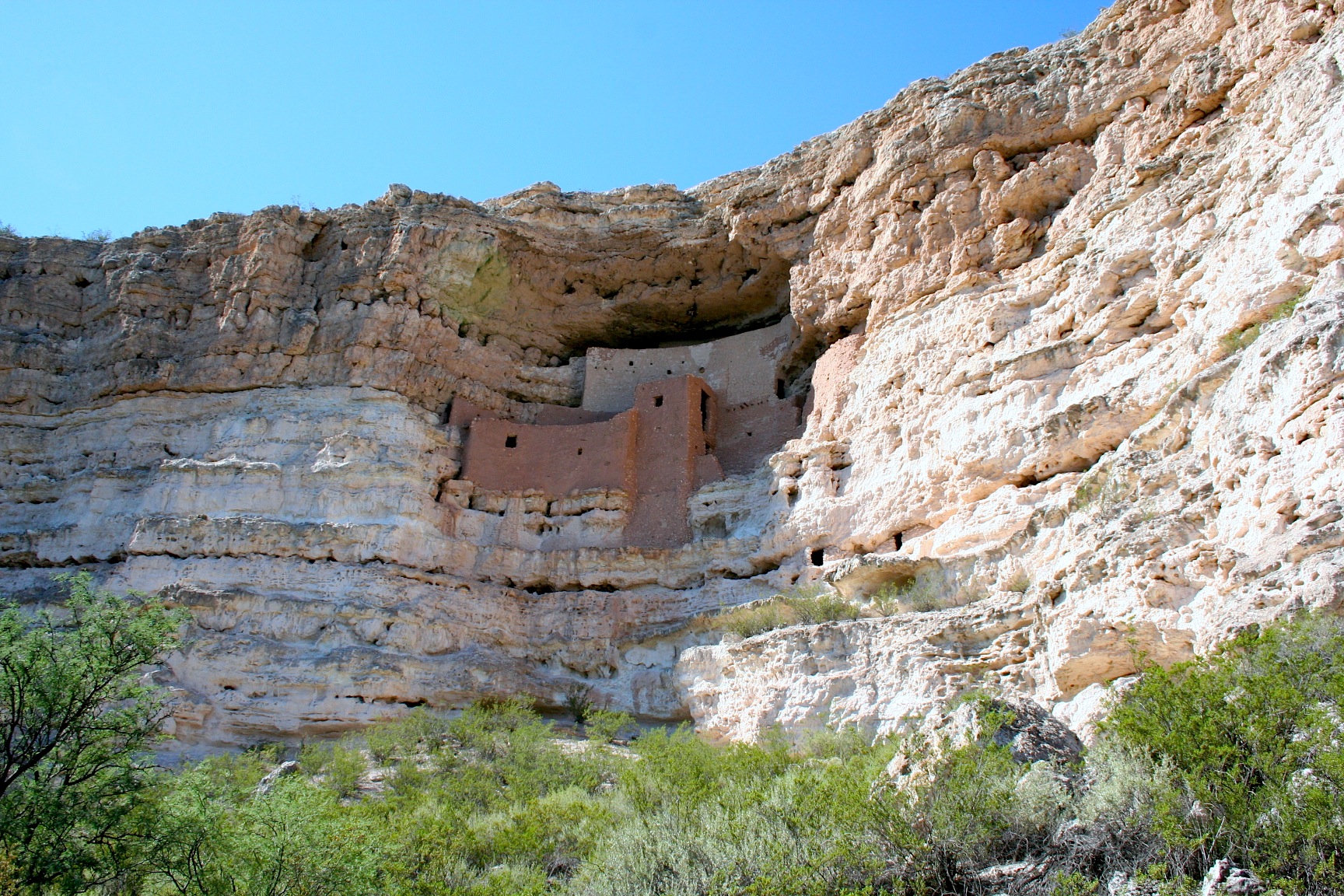
The thing that makes Montezuma’s Castle so impressive is the perch on which it sits in the side of a tall pale white cliff. A lower and more forward portion of the building is a reddish colour, and flows almost seamlessly into the straight edge death drop side of the cliffs. Just behind it is another section that takes on the colour of the cliffs below it. All that is missing is a beautiful panoramic set of windows that look out and down across the lightly forested plain and stream below. Then again, in the Arizona heat, I understand why they only had a few gaps in what is otherwise likely a nice cool spot. In cases of battle, the fifty or so residents would have been essential unreachable compared to their neighbors living on a small hill.
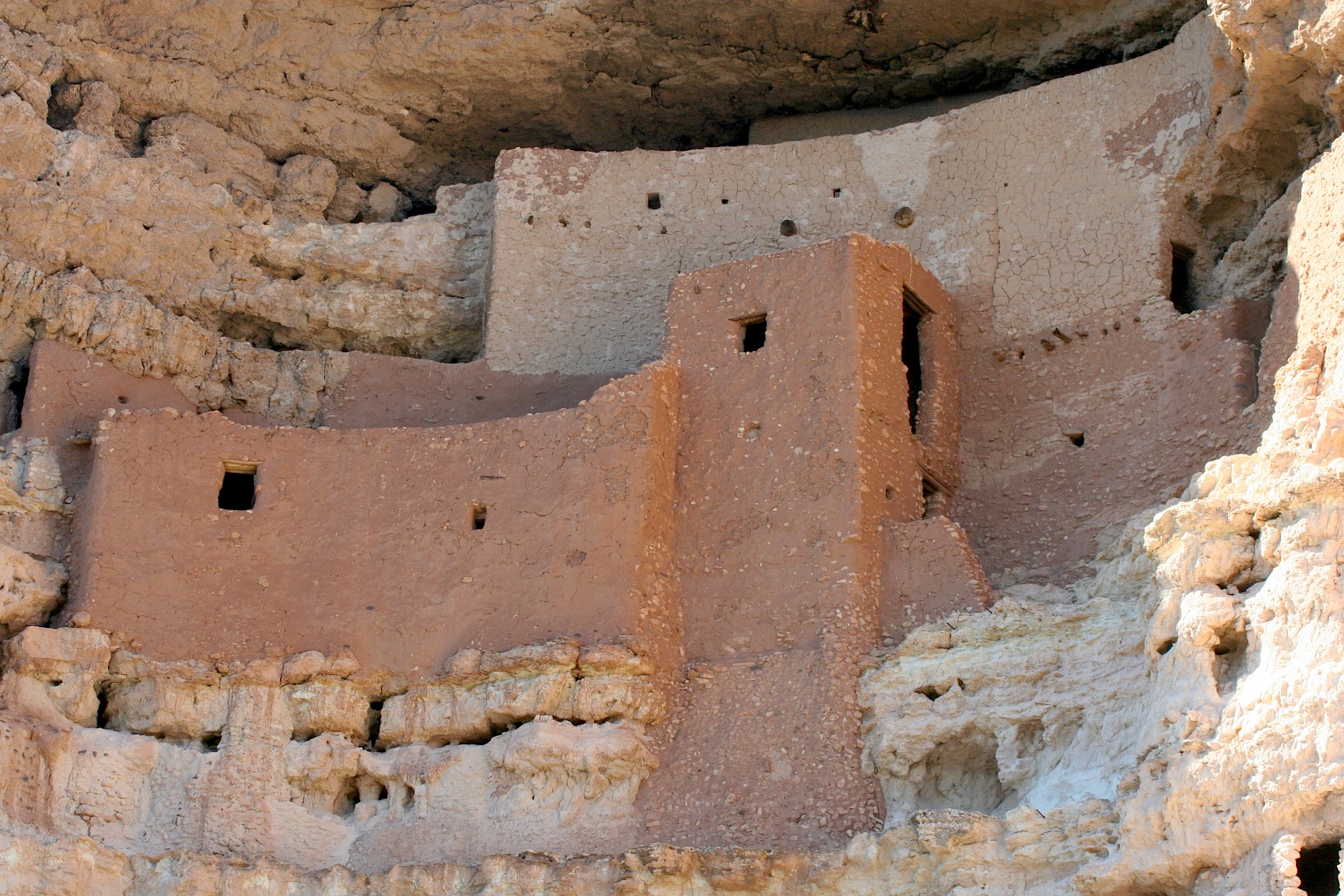
Some of the really beautiful things about the castle are its colours. The sites I mentioned so far are all well blended with their surrounding rock, as would be expected. Over the years, any decoration that may have once adorned them is long gone. Many ruins easily fall into the background of their surroundings. Now, Montezuma may have a bad reputation in Mexico for poisoning tourists, but he certainly did have good taste when it came to design. The pale white cliffs that frame the high-rise condos are actually divided into a lighter lower portion, and a darker redder upper portion. Put the two differently coloured sets of walls into the spot where this transition happens and you end up with a beautiful little area where the rock face inverts on itself. As your eyes flow across the horizons of the rocks, suddenly the red flips to white and vice versa. It is a small detail that part of me wants to be an accidental reversal of what was intended. For obvious reasons, any form of camouflage would be better suited if the situation were overturned. Instead, the different coloured building material help it pop out from the rock in which it is nestled.
No good extravagant castle is good without a nearby get away. Now, I want to take just a second and remind everyone that this isn’t actually a castle. It is called one, and I use the name to express the gravity of the place, but culturally the similarities stop there. However, it is associated with another site not too far away but on separate grounds of the same name. Montezuma’s Well. I like to save the best for last, and this by far is one of my favourites.
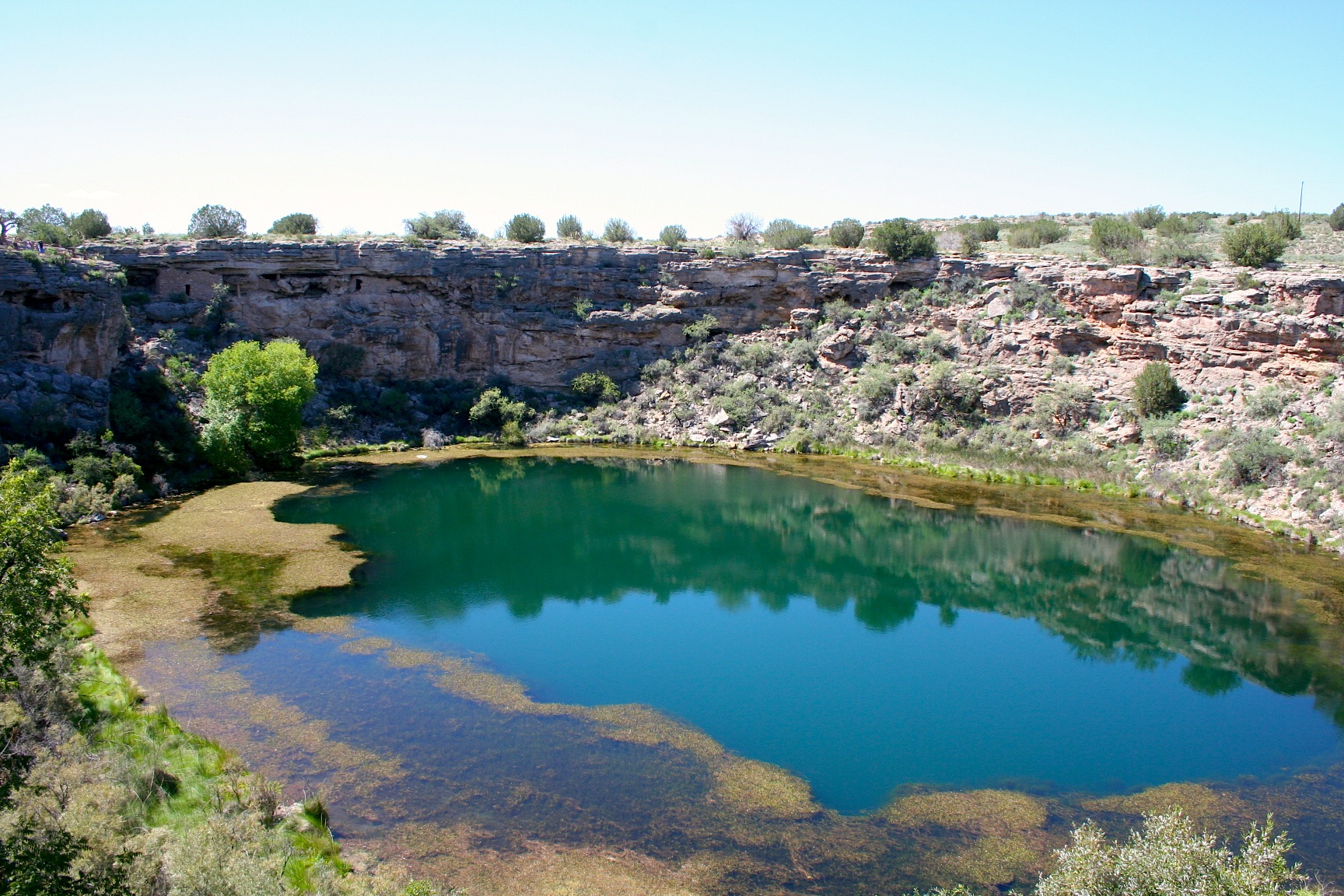
Montezuma’s Well is not a well-known place. No historic battle took place at it, no one famous drowned in it, it isn’t the largest pyramid in the country, nor is it really of any note to the general public. Frankly, that is a part of what I love it so much. The well is a large limestone sinkhole that stretches down between fifty and a hundred feet to its bottom. Two natural vents of water pump in a million and a half gallons of water per day, keeping the well at a relatively stable level even in droughts. Along the inside rim of the well are small homes like those at Walnut Canyon, built around preexisting walls and overhangs.
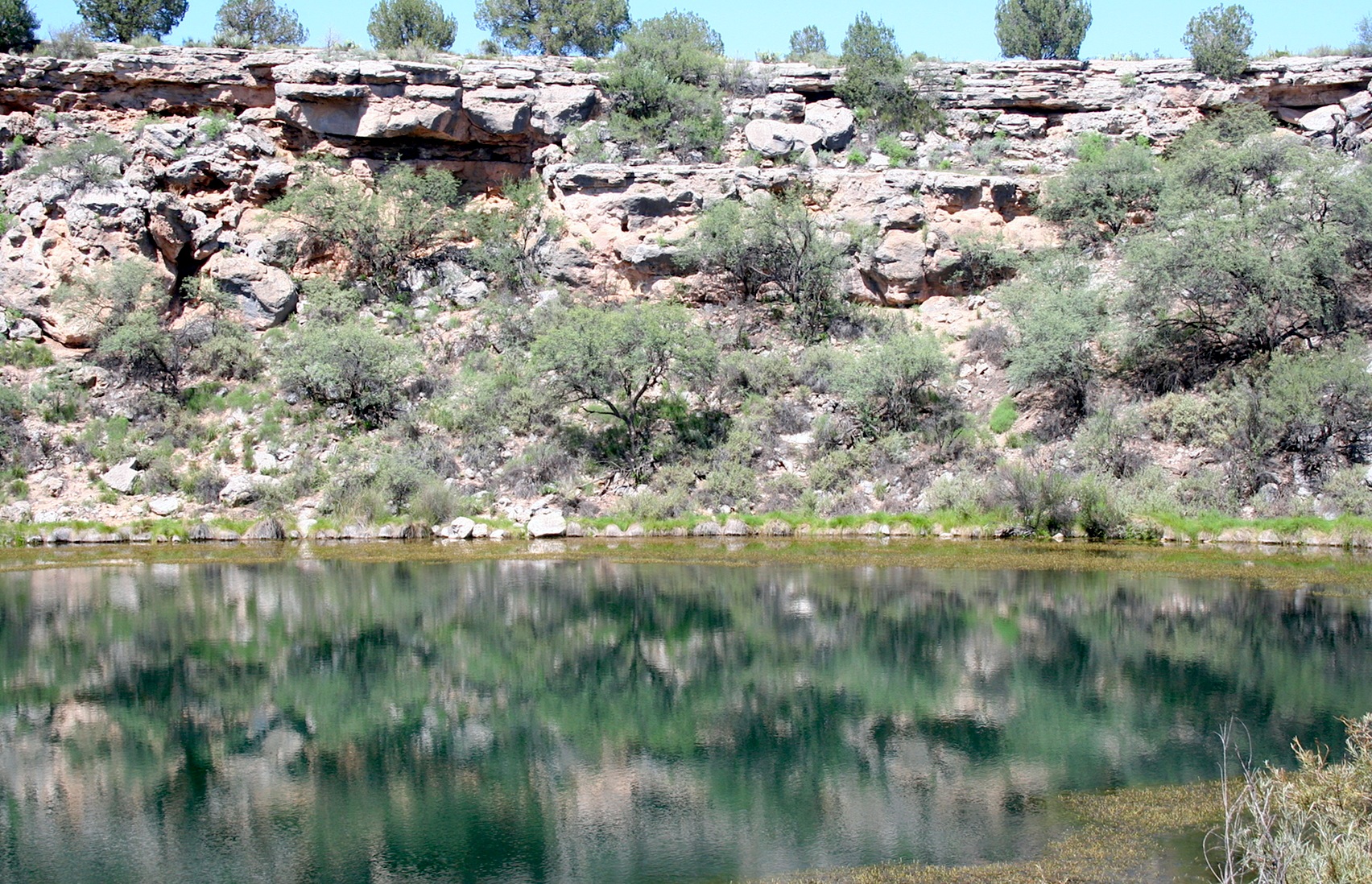
The limestone walls are a similar pale white to the walls of the castle just down the road. Outside the sinkhole are shrubs, dry, dusty, and dead. It looks a lot like the desert. In the pit however the water is still and deep green. The glassy smooth surface acts as a mirror, reflecting the sky, which highlights parts of the well in bright blues. Though it is a small oasis in the desert, the stillness and reflection of the sun make standing on its upper rim almost more unbearable than the open shrubby desert beyond it. I said that it is one of my favourites, and yet my first impression of it was, “This must be where souls enter into hell, because this is terrible.” It was pretty, sure, but the hot, bright, dead air was just not how I imagined spending my time at a “well.” Now, all that water has to go somewhere, and that outflow is where I found a truly calming oasis.
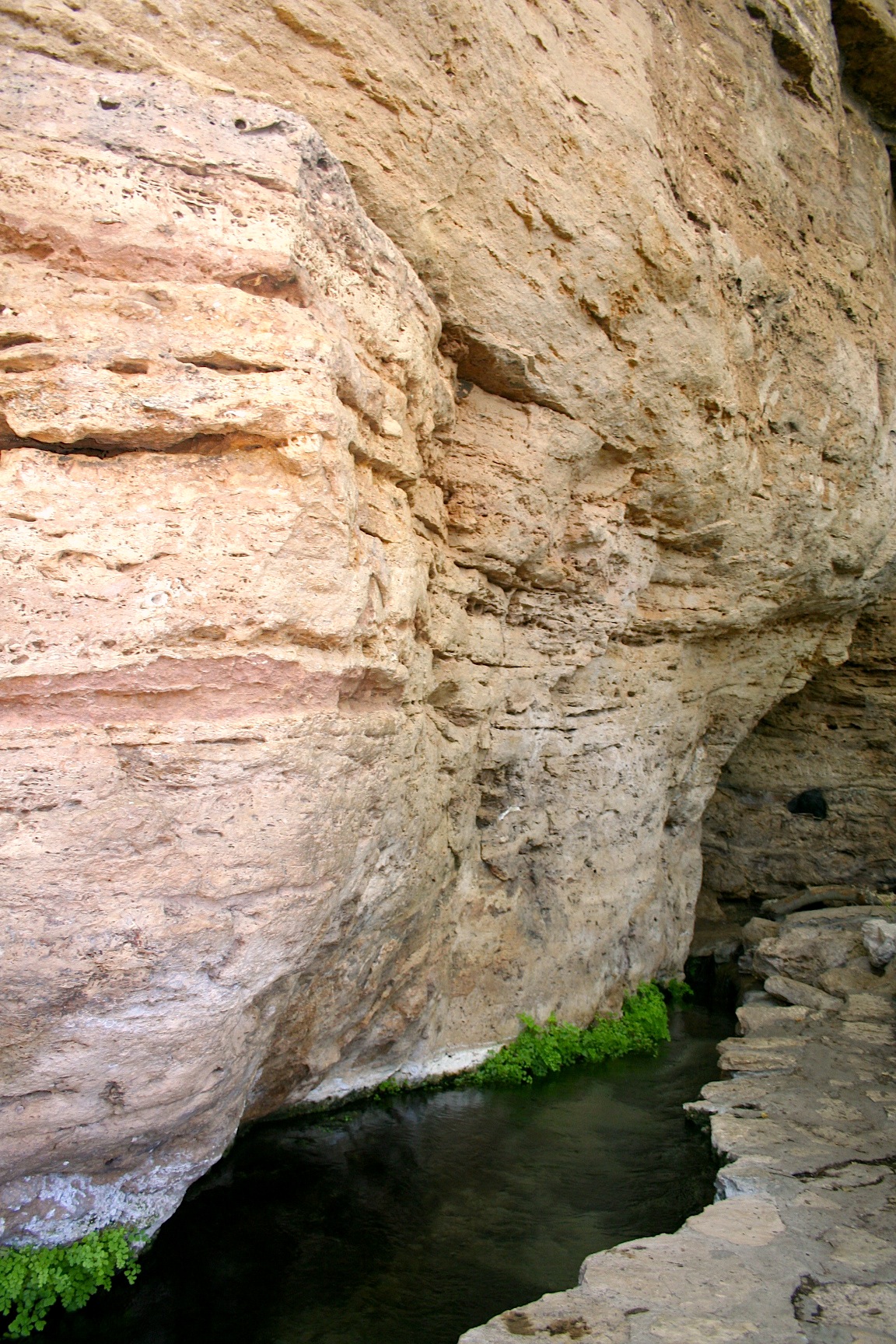
It isn’t really much for an oasis to be honest, but something about it was beautiful. The water that filters through the well eventually makes its way out via a small stream that runs up against a limestone wall. It leaves not murky and slimy like it sits inside, but clear, crisp to the touch, and frankly rather enticing. I could hear the jokes about getting Montezuma’s Revenge from Montezuma’s Well, so it was decided against. It would be just too cliché. That is enough bowel commentary though.
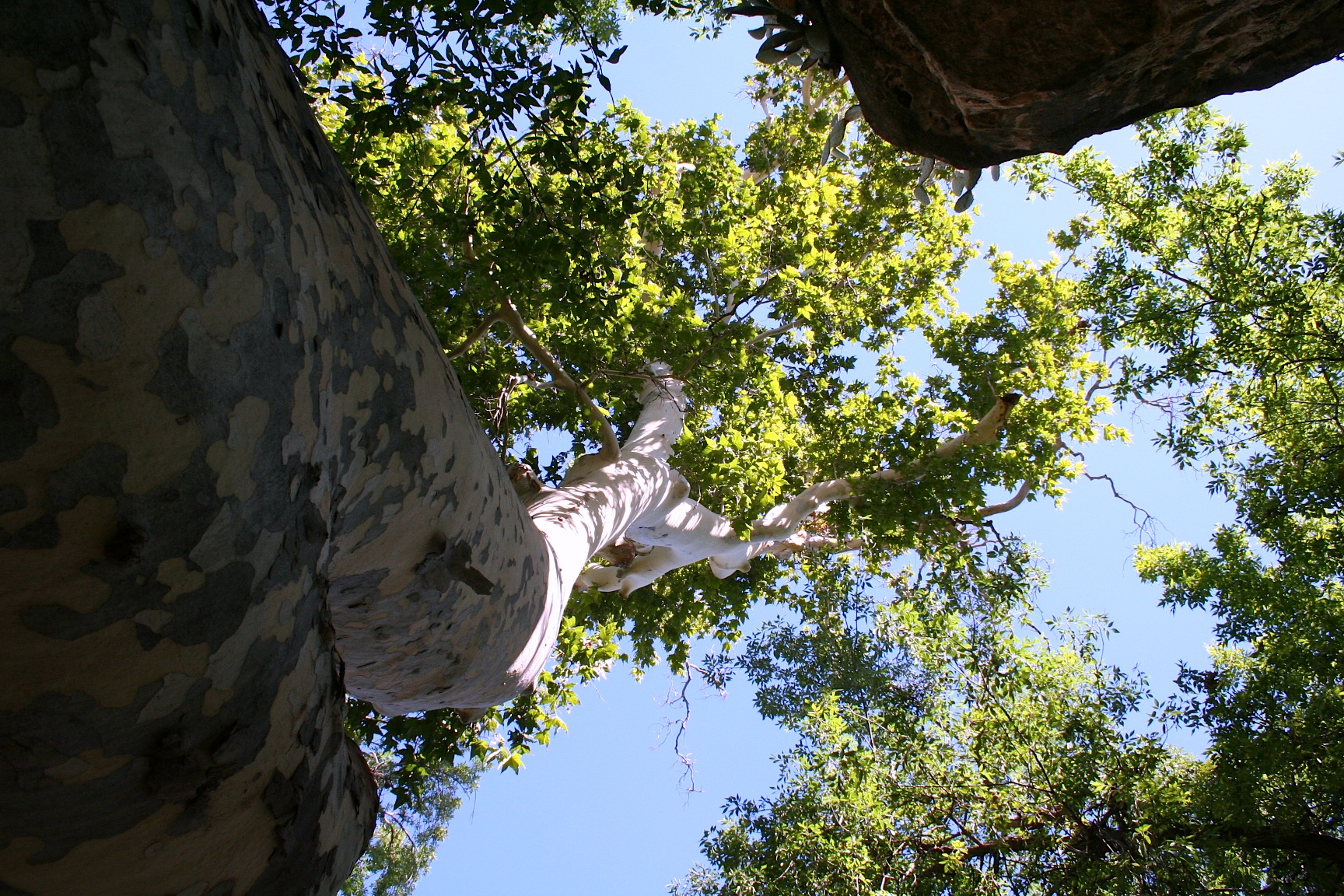
On the edge of the stream, green plants huddled together. Green like the kind that need water to survive and grow in gardens. Not desert green. The shade of a giant tree, I dare not try to identify what kind it is for I will fail, and others mixed with the flowing stream brought the temperature down what felt like twenty degrees. The water made just a slight bubbling sound that tore through the buzzing hum of midday desert sun. In the water were the white roots of plants, carried with the flow of the stream like ribbons in the wind. Each rippled and twisted around the others, blurred by the rapid flow of water.
I don’t know why such a small place struck me so much that I feel the need to share it with others, but it was a moment. One of those moments that for no other reason seems to have a profound effect. Maybe it was for no other reason than the escape from nature in nature that made it so memorable. For none of the individual elements of the outflow make it very special. Yet I melted. Not from the sweltering, moisture sucking, soul crushing heat, but from the calm stream that flowed out of a slimy sinkhole.
 Steerage Yearns