
Teotihuacan
Ever wandered around an archaeological site and wondered what it was like when it was? Like actually WAS. Not what it looked like before some earthquake in 1598CE took down a wall or before (insert opposing waring people here) burned part of it down in 1675C. What it was like to experience said place. For me, the true experience behind most archaeological sites is essentially gone, dead and dry as the stones that remain. Sure we can see some amazing artifacts in museums; behind glass, mixed in with similarly shaped or used things, completely out of their actual context of use. But we are not talking artifacts today, were talking about the site itself. Not to be misunderstood, these are amazing places. I am an anthropologist by training so I have no choice but to love these things, but there is so much missing. It is like trying to understand or experience New York purely through the architecture alone. No food, people, animals, newspapers, garbage, taxis, or culture. We take what we are given and create a mental image as best as we can to feel a place. Ok bear with me, this is going to be relevant.
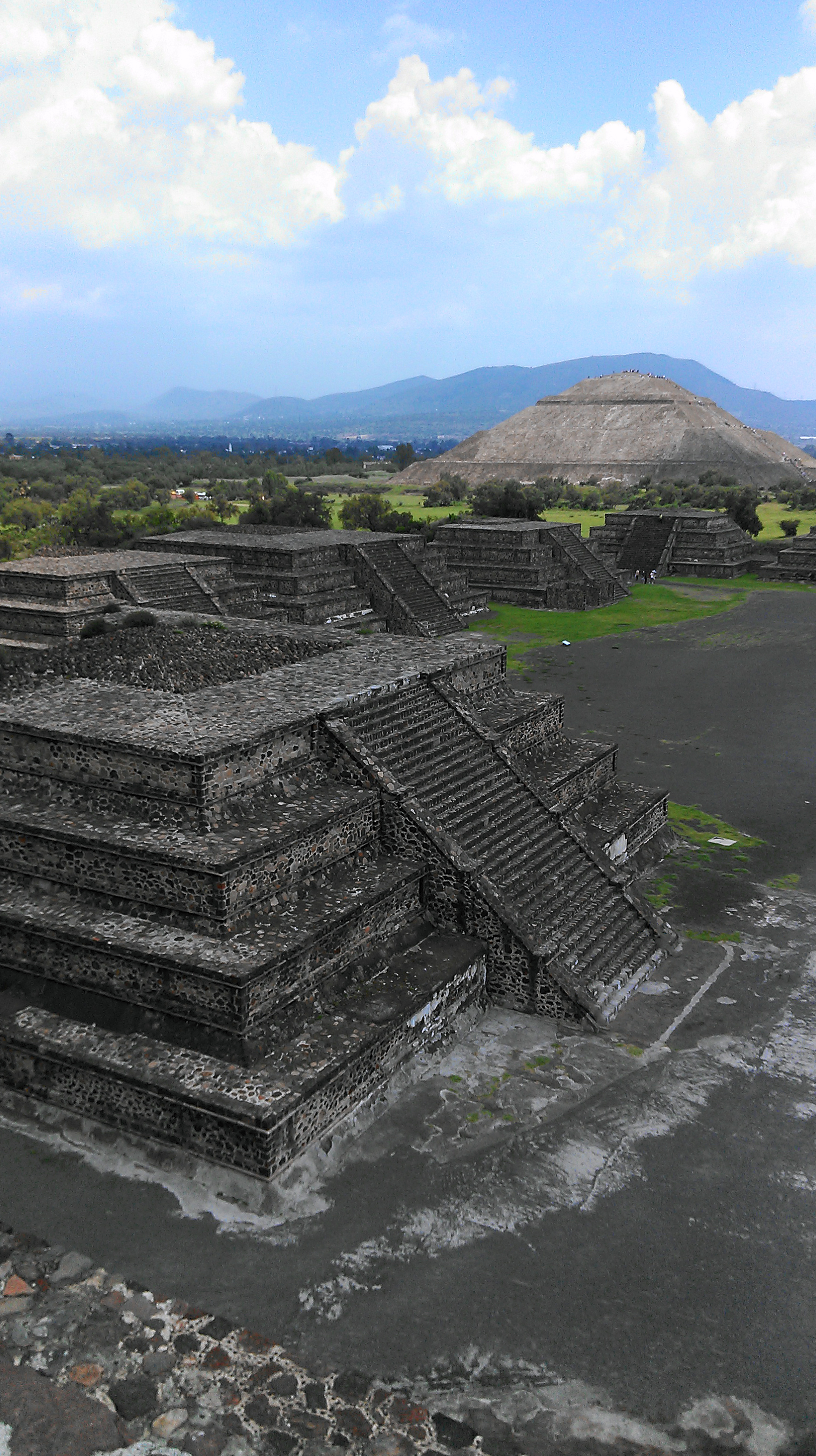
Pyramid of the Sun as seen from the Pyramid of the Moon.
Teotihuacan is one of the more awe inspiring archaeological sites out there. Around two thousand years old, and likely home to more people than Erie, Pennsylvania is today, it is amazing. The preservation is truly unbelievable. Intricate patterns of stones look like they were laid out in the 1950s as part of an elaborate ruse to get tourists to come see “The Pyramids of Mexico.” When walking around, we have a very clear idea of what the site must have been like at its peak. Bustling like a modern city, animals and people everywhere. Different sorts of shaded structures or alters sitting atop platforms on miniature pyramids. A glistening moat around the largest man made structure anyone at the site would ever experience. Likely a blood stained staircase, bottomed by corpses of the sacrificed. Can almost even smell the decomposing garbage that was probably piled in some areas, or the food being cooked and sold in the plazas.The intricate detail of the structures at the site after two millennia forces the mind to create elaborate stories and movie style ghostly overlays.
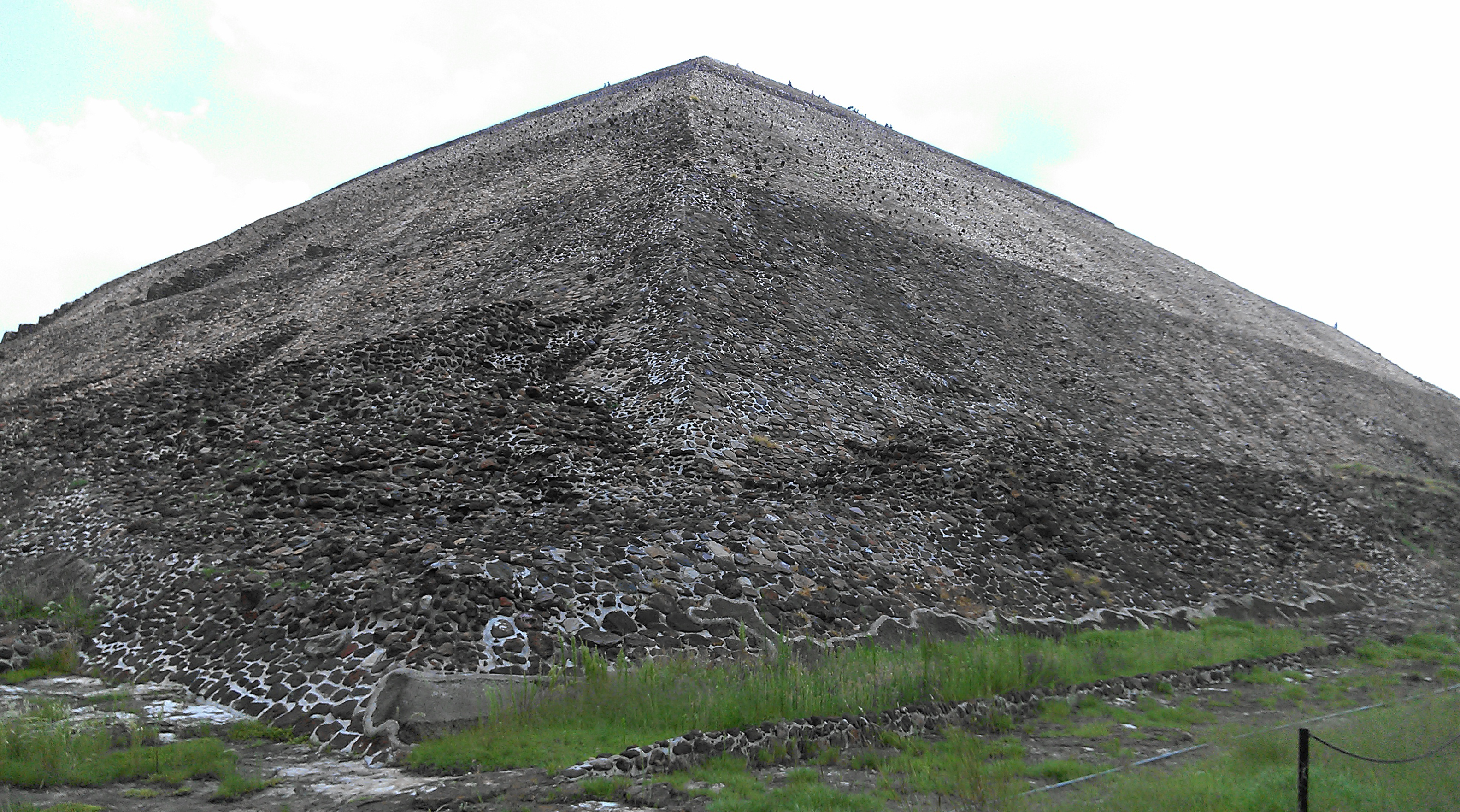
Pyramid of the Sun from its northeast corner.
Now for a warning. If you want to keep this image of Teotihuacan, look at the pictures below and call it a day. There is nothing wrong with that. The reality however may be bit less romantic. The elaborate and geometric detail of the structures most beloved by tourists at the site is largely artificial. The fact that Teotihuacan has not been sitting, nearly unchanged for over a thousand years should surprize no one; but the extent of the reconstruction, and total lack of any attempt at transparency may be more surprizing. I do not intend to say the site is some artificial tourist trap, rather that the parts that are most visible and most admired, in part for their preservation, should been viewed skeptically.
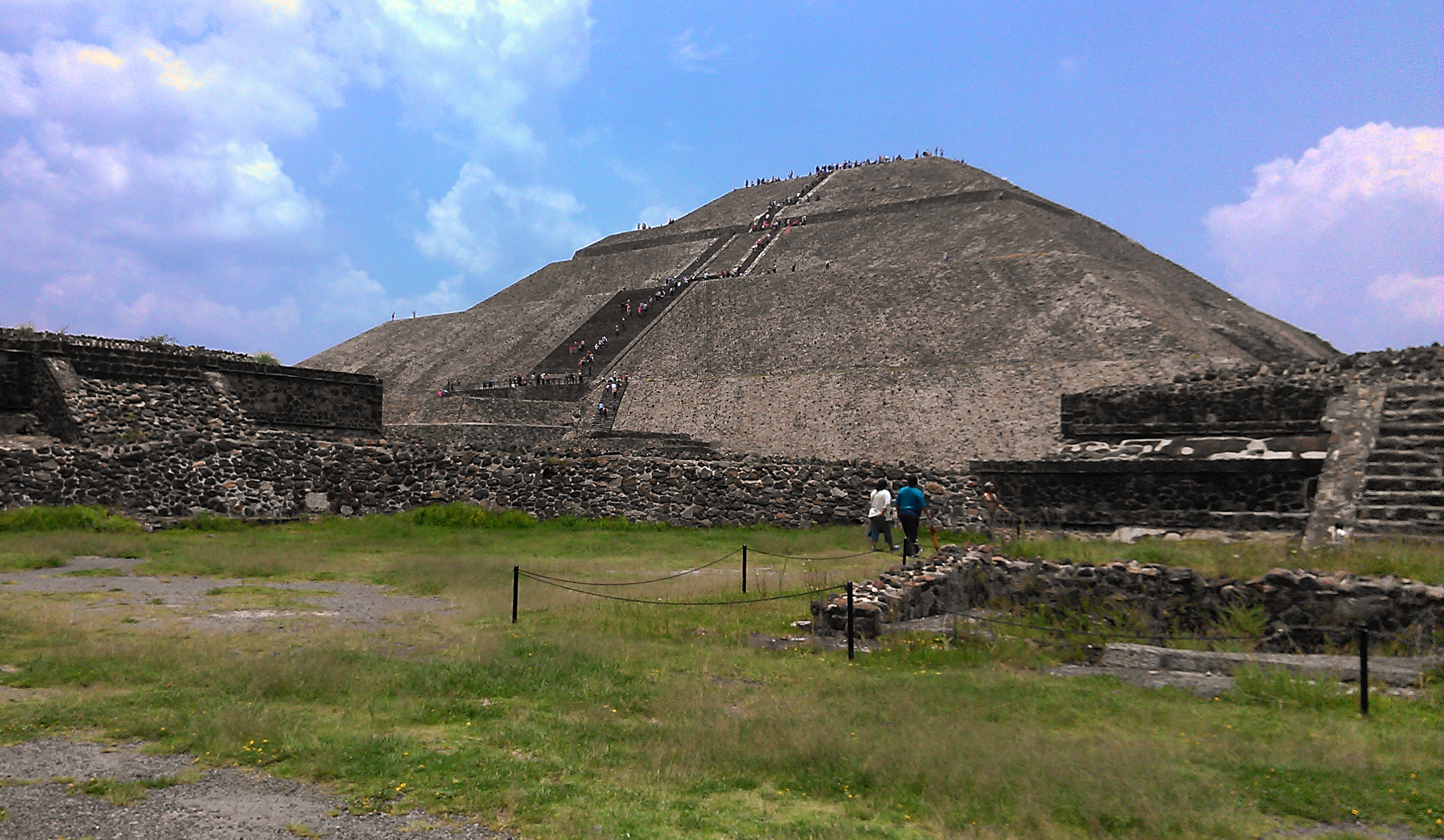
Pyramid of the Sun as seen approaching from the south end of the Avenue of the Dead.
The vision of two thousand year old perfect starts to fade somewhat early if you look for it, and even if you don’t to be honest. For example, the Pyramid of the Sun has a rusted pulley and anchor system seamlessly incorporated into the third level’s north face. A use of materials not likely to have been common place during the construction of said site. There is also a double staircase part way up the same structure. According to at least one person, the staircase on one side has 48 steps, the other 50. For a site where nearly every structures’ N-S walls are aligned almost perfectly to nearly due north, it seems unusual that symmetry would not be important, even in something seemingly insignificant such as the number of steps. I cannot personally confirm this claim, only one set of stairs has a “hand rail” and therefore was the one we used by my associate and I. Either way, the concern was more about not re-enacting an ancient sacrificed body fall than counting numbers of steps. Additional traces again relate to asymmetry and lack of alignment. While it is not impossible these choices were made intentionally, or that simply successive rounds of construction did not align perfectly, the clean lines and clear planned design of the site, make these abnormalities scream imperfection. The first is less obvious, but again relates to the Pyramid of the Sun. The platform on the front of the structure, where the staircase meets the ground is crooked, more apparent from above (via airplane/hot air balloon/Google Earth), but still noticeable from the ground or the pyramid itself if one is paying attention. It just isn’t right. The second is nearly painful to look at.
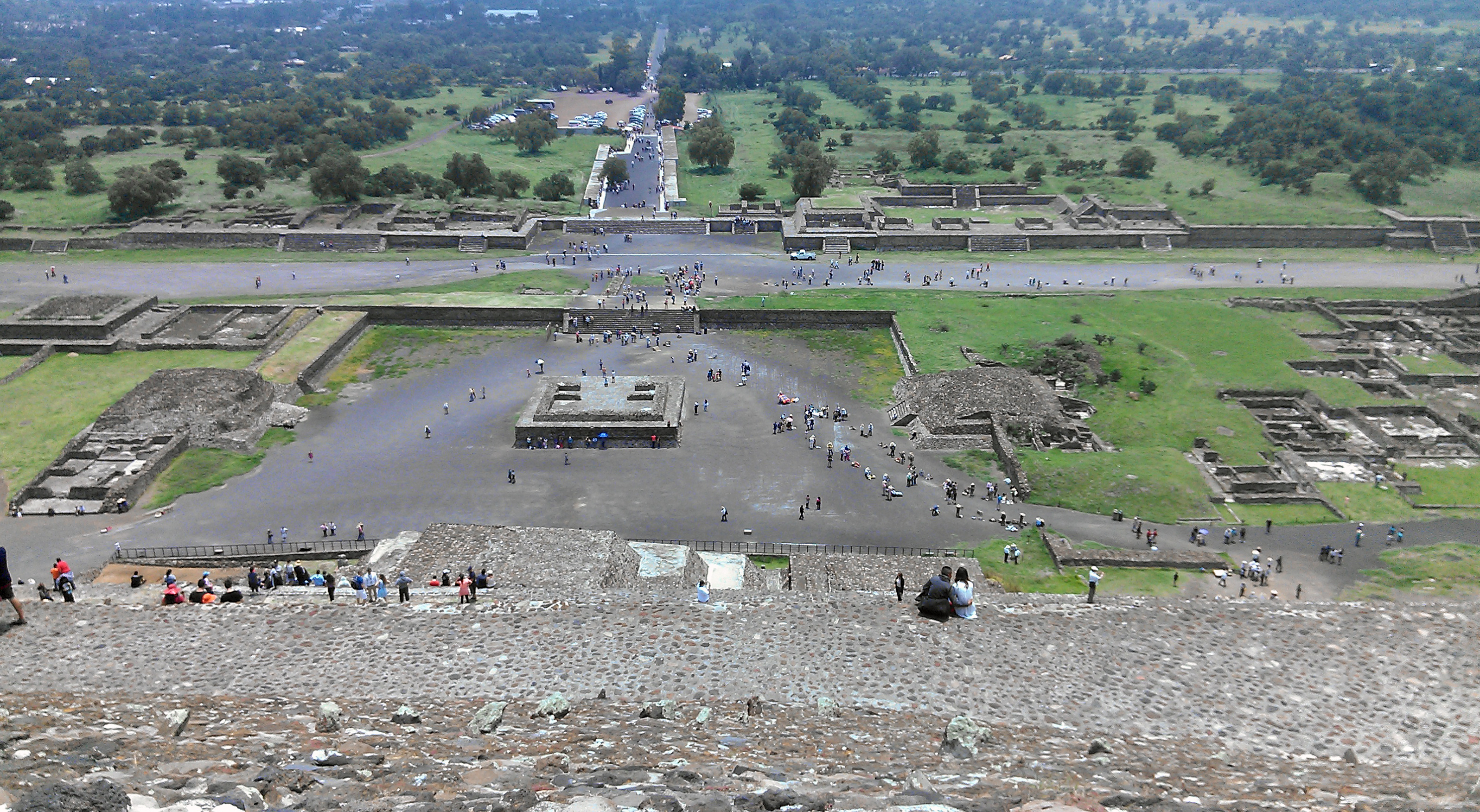
Crooked platform near the base of the stairs on the Pyramid of the Sun.
Walking down the “Avenue of the Dead” toward the Pyramid of the Moon, it is easy to be struck by the symmetry and centering of the stocky yet imposing pyramid. The potential is really in that it should go unnoticed, to simply be impressive. The onlooker might be expected to feel small and in awe of the view, but also a bit uncertain of why they have this feeling. However, what actually happens is a slight difference in the angulation of the stairs that makes the focal point of the entire precession “who screwed that up?”

Misaligned stairs on the Pyramid of the Moon. Only picture I took of it where the misalignment is apparent.
The answer, at least in the case of the Pyramid of the Sun, and likely others at the site is Leopold Batres circa 1910. While likely acting with the best of intentions, he did some pretty poor reconstructions. The most well-known, and likely most unnoticed of which is the addition of an entire platform to the pyramid of the sun that likely never existed. There are currently five large step-like platforms of different widths that give the pyramid its unique appearance. In all actuality there were probably only four, oops.
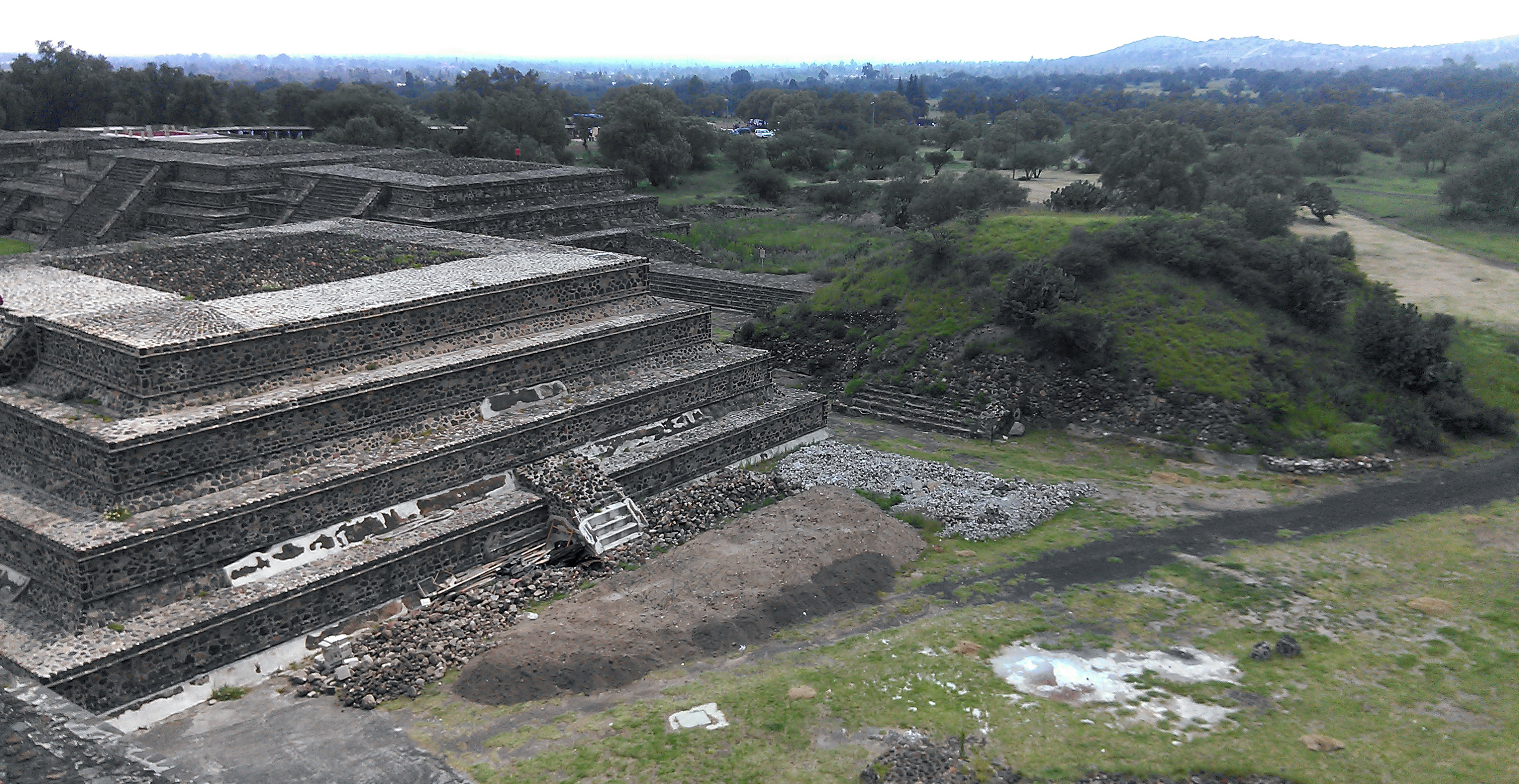
A platform near the Pyramid of the Moon that was not reconstructed. Not as pretty to look at for sure.
For a better idea of what the site may have looked like without any reconstruction I refer you to the 1880 photography of Désiré Charnay. While he took photographs of many sites in the region, of particular interest for my purposes are the digitisations of numbers 68, 70, and 71 down on the bottom of the page. Take a second to look at those three. Back? Ok, a little bit has changed since 1880, no? Maybe a lot actually. This isn’t a shock to some people, but it is not simply that some dirt and plants are growing on a pristine pyramid that needs a good dusting. Both structures are essentially piles or their former material beings. With that taken into consideration, it becomes very clear that even some of the reconstructed pyramids are only so on their faces that are visible from the Avenue of the Dead. Have to bring up the curb appeal before celebrating 100 years of independence (1810-1910). And it all starts to come together.
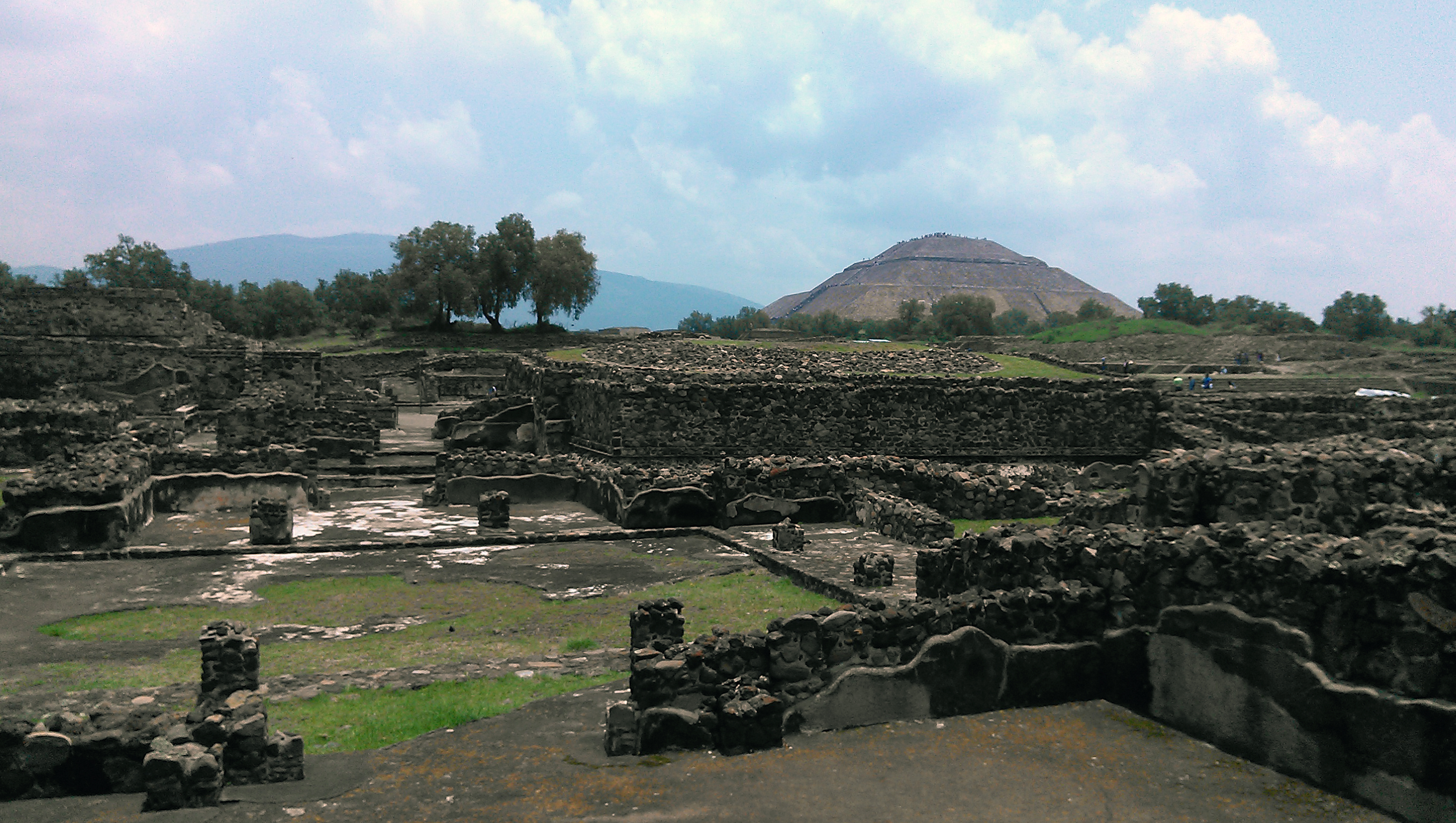
Pyramid of the Sun with surrounding ruins. Most tourists visit only the two large pyramids and miss the vast majority of the city sprawl.
Putting all of that aside, Teotihuacan is a truly amazing site that we as humanity know very little about. It was already abandoned before the Aztecs arrived and “discovered” the site. There isn’t even a clear agreement on the group of people who built what was at least the sixth most populated city on earth during its prime. That is just insane, isn’t it? I wonder how many people showed up for the end of the Mayan calendar on December 21, 2012; unpleasantly surprized to find out that not all Latin American pyramids are Mayan. Even with all of its reconstruction problems, and who knows how much information that was lost thanks to Mr. Batres; it is a site to be seen.
The moral of today’s rant is that we always look at the past through the lenses of our own experiences. More often than not we know that, but what we don’t know is we are also very often looking through the eyes of people who lived and existed temporally between then and now. In this case, the archaeologists, builders, Leopold Batres, and likely many others have a huge hand in what we perceive as Teotihuacan. They created the aesthetic we take for granted today over 100 years ago. For better? For worse? Not really sure I have an answer for that. Only that it is what it is, and that there is a history of Teotihuacan that has very little to do with pre-colonial peoples, culture, art, architecture, or life. Yet it has everything to do with what we visit today, over a thousand years after the architects of the site had died.
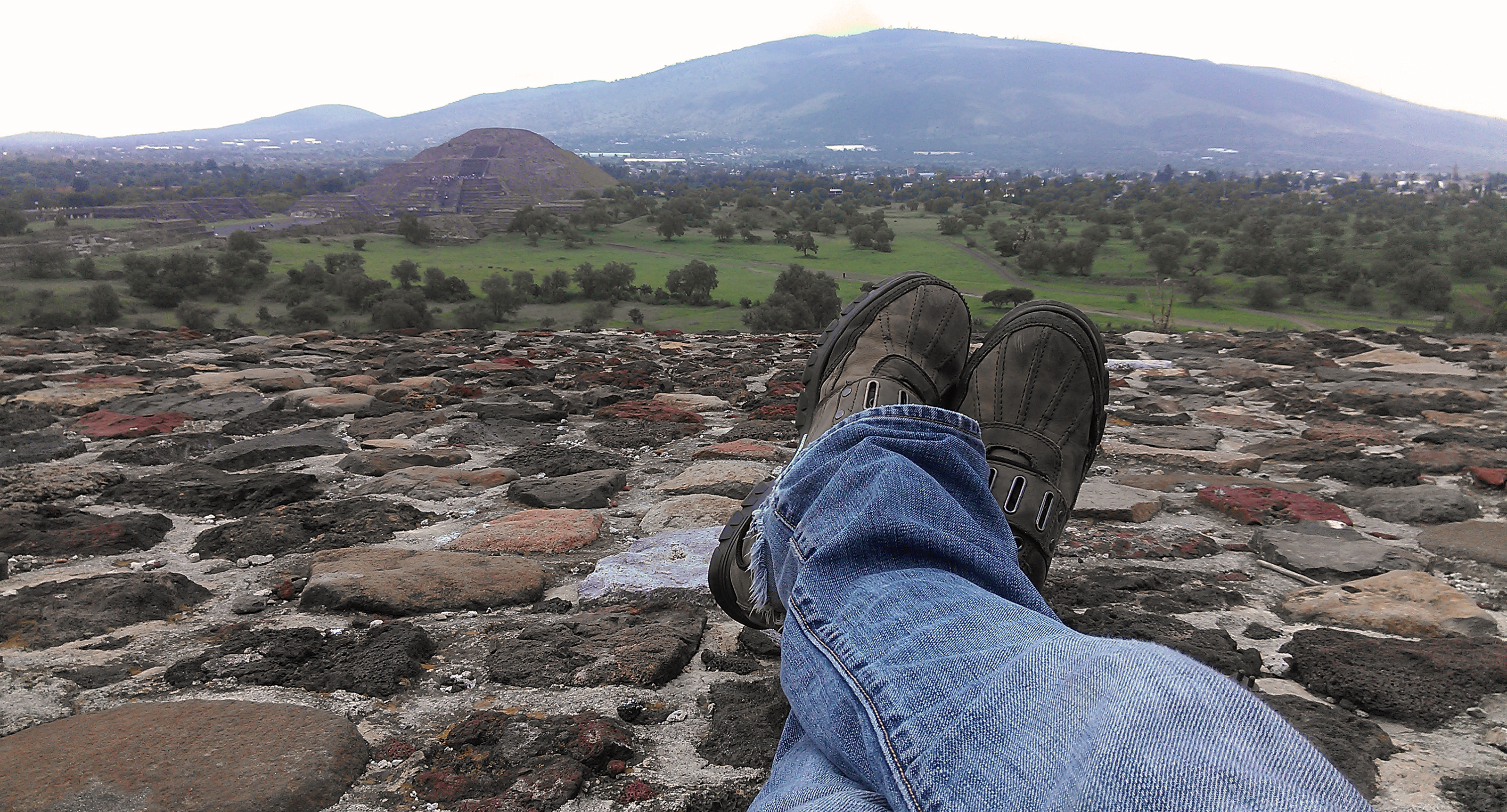
 Steerage Yearns
This is wonderful, as always your best fan!